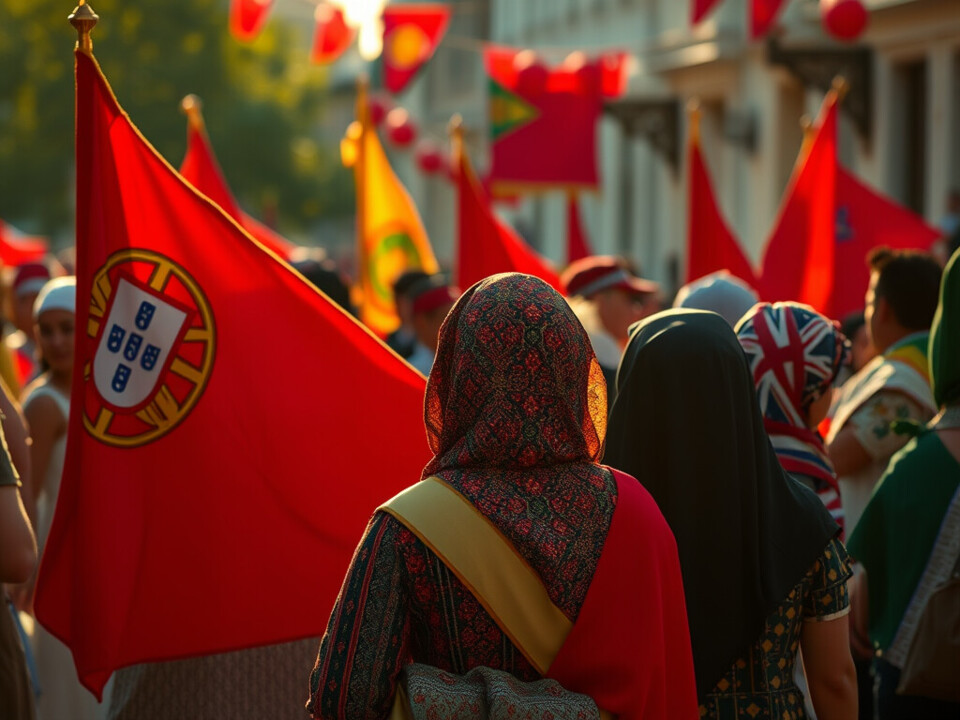
Cultural appropriation is one of the central post-material battlegrounds of the contemporary world. It mobilizes questions of identity and culture, while often overlooking a foundational principle of culture itself: hybridity.
At its core, the concept of cultural appropriation refers to the use of cultural elements—symbols, clothing, hairstyles, cuisine, religion—originating from a minority group by members of a dominant culture. This usage is commonly seen as a form of disrespect and, implicitly, as a claim of ownership over those elements. In a time when culture is highly politicized, the subject demands careful and nuanced analysis.
The very notion of appropriation entails two problematic assumptions:
(i) that there exist authentic, untouched cultures;
(ii) that any use of minority cultural elements by dominant groups is inherently a violation and a sign of oppression.
Let us take each in turn.
Cultural hybridity can be systematically understood as a continuous and dynamic process of mutual fertilization and re-symbolization. It generates new cultural objects, often at the cost of tradition, while preserving the memory of the original ones. But the encounter of cultures—seldom peaceful—is part of the human story. Catholic imagery of saints, ex-votos, and pilgrimages, for example, owes much to Roman civic religion and Celtic spiritual practices. In this light, “authentic” or “pure” cultures—an idea explored early on by Afro-Brazilian scholar Roger Bastide—are a myth. Inauthenticity is, in fact, the hallmark of all cultures. Claims of purity are political acts, rooted in collective memory and identity, and “authenticity” is a social construct.
The second problem—the assumption that dominant groups using minority cultural elements is necessarily an act of oppression—stems from the rise of Critical Theory, particularly its Gramscian threads, which frame all relations in terms of systemic domination and emancipation. Taken to extremes, this perspective fosters a doctrine of absolute and eternal Western guilt. This is particularly evident in the asymmetry of the discourse: the term “cultural appropriation” is rarely invoked when a minority group adopts or reinterprets elements from the dominant culture.
In Woke Racism, John McWhorter notes the contradiction: white people are expected to respect, praise, and elevate minority cultures—but not touch them. This resembles a form of secular religiosity: cultural objects are placed on sacred altars, to be venerated but never used. Yet a white person can (legally and morally) incorporate cultural elements into artistic reinterpretations, culinary fusion, or aesthetic appreciation without necessarily committing a cultural offense. The only justification offered for the claim that a Black person may wear an Italian suit or a Scottish kilt, but a white person must not wear dreadlocks (a hairstyle that has existed in various forms across many non-African cultures throughout history), is that of historical oppression—an idea then crystallized in the notion of cultural appropriation as inherently disrespectful.
That said, the issue is not black and white. Cultural appropriation can indeed constitute symbolic violence. It becomes problematic, for example, when white supremacist movements adopt minority cultural symbols (such as dreadlocks) as emblems; or when dominant groups temporarily borrow minority elements purely for commercial gain; or when Western New Age movements adopt non-Christian religious symbols and strip them of their original meanings. Even pop culture is not immune—consider Marvel’s use of Thor as a superhero, which many argue trivializes a religious deity.
In conclusion, we must draw a necessary distinction between:
(a) a puritanical and politicized idea of cultural ownership, which holds that cultures and their elements belong exclusively to certain groups, and that usage requires permission—thus denying the inherently hybrid nature of culture; and
(b) genuine cultural appropriation, in which the use of cultural elements is so detached or commodified that it distorts or desecrates the dignity and meaning of the original culture.